Worldbuilding
The broad strokes of Eusia itself.
If it describes the world and how it works, put it here.
- Kingdom of Eusia
- Geography
- Politics
- Eusaria (Capital city)
- Duchy of Vermillion
- Duchy of Summervale
- Duchy of Marvane
- Duchy of Ironwood
- Duchy of Greycliff
- Duchy of Broadwater
- Northern parts of the continent
- Factions
- Dalaichin Nomads
- The Still Chain
- The ledger of the calm seas
- Zaharan (Tabaxi) Tribes
- Tabaxi trade caravans
- Esmeralda’s Gold
- Malakyzia’s Right
- History and lore
- Origins of the Dalaichin Nomads
- Open Halls of Thunder
- Stormward Sanctuaries
- The Sapphire War
- The Gander & Goose Public Houses
- Gods, Deities, and Greater Powers
- Faiths, religions, and superstitions
- South of the kingdom
- The Zahar
- Ri'Shara
- Donnerwald
- Oak Landing
- The Donner River
- Southern tundras
- Skyfather's Hall
- Wolkenruh
- Duchy of Ironwood
- Duchy of Greycliff
- Languages
Kingdom of Eusia
Geography
The kingdom of Eusia is situated in the temperate zones of the Continent of Eusia. It's area is roughly 300 miles north to south and 150 miles east to west (which is coast to coast.)
It's northern border extends to the wild edge of the conifer forests that stretch across this portion of the continent. The area beyond the border is poorly mapped and even more poorly understood by the folk of the kingdom. There are only rumors about who or what may live within and beyond it's reaches. (See Wild North Hexcrawl for an adventure in this region.)
It's southern border extends to the untamed desert. It is a region resembling the American south-west, with rocky red earth, scrubland, mesas, as well as mountainous areas. It is home to many tribes, all of which resist the Kingdom's attempts at trade, settlement, and negotiation. Deep within the desert is a single settlement which finds itself allied with the Kingdom, and only through their ingenuity have they survived on their own in such hostile territory for so long (See Land of Enchantment Adventure for an adventure in this region.)
It's western border meets the Western Ocean and is riddled with steep cliffs. These are difficult waters to navigate, and there are no places to build large ports. As such, trade along the west coast still travels by ox-cart, and forays into the water are reserved for agile vessels which can maneuver away from and back to the treacherous shore.
It's eastern border meets the Eastern Ocean and is far more pleasant than it's western counterpart. Natural harbors, sandy beaches, and reliable climate mean that ocean faring trade is commonplace. There are several islands which can be reached from this coast, none of which technically belong to the Kingdom, though many are reliant on trade from it.
At the center of the kingdom is the capital city of Eusaria from which the King rules. Politically, it is it's own Duchy, though it's territory extends only perhaps 5 miles from the city's walls. Nevertheless, it is the seat of power for the whole kingdom, and a merciless political machine.
Politics
The Kingdom is currently ruled by King Alden XVI with his wife, Queen Catherine Valis beside him. It is a place of historic peace, though the rising tension of economic imbalance and political strife are becoming more common. Things are quietly falling apart, though the king has spared the central provinces at the expense of letting the northern border territories suffer.
Currently, the Kingdom is divided into 7 Duchies:
- The City of Eusaria, ruled by King Alden XVI
- Duchy of Ironwood, ruled by Duke Cedric Blackwood
- Duchy of Broadwater, ruled by Duchess Beatrice Marrow
- Duchy of Vermillion, ruled by Duke Ignis Vael-Khor
- Duchy of Marvane, ruled by Duke Alistair Sterling
- Duchy of Summervale, ruled by Duke Julian Thorne
- Duchy of Greycliff, ruled by Duke Cassian Blackwood
Eusaria (Capital city)
Eusaria is the capital of the Kingdom of Eusia. It is the Duchal seat of the King, King Alden XVI. It is the largest city in the region by far, and acts as the beating heart of the society of Eusia.
Duchy of Vermillion
This is a duchy within the Kingdom of Eusia. It is lead by Duke Ignis Vael-Khor. It is the largest duchy by area, and is situated to in the west. It's northeastern corner borders the capital, and it's land stretched from this midland all the way to the western sea. It's norther border is mostly shared with the Duchy of Marvane, though there is a small portion on the northern tip which borders the Duchy of Greycliff. To it's east is the Duchy of Summervale with which it shares a strong alliance. It's southern border is a great desert, who's tribes resist all attempts at trade, diplomacy, and conquest.
The Duchy of Vermillion is powerful and militaristic, plying a roaring trade of worked metal goods and mercenaries. The ruling family are Dragonborn, a change which occurred less than a century ago. The majority human populace, ever pressed into military service, have a convenient scapegoat in this family, and rebellion is never far from breaking out. It has rich mineral deposits and skilled smiths.
Exports: Weapons and Armor, The Iron Legions, Copper and Tin
Imports: Warhorses, Grain
The Ducal capital is Obsidian Gate, named for it's massive black-stone walls.
Duchy of Summervale
This Duchy in one of several which comprise the Kingdom of Eusia. It is lead by Duke Julian Thorne. It is a medium-sized duchy in the south-east of the Kingdom, who's southern border meets with the desert and eastern border meets the Eastern Ocean. To the north, it shares a border with the Duchy of Broadwater and slightly west of that, the Capital City. It's western border is shared with the Duchy of Vermillion, with whom they share an alliance.
Sprawling tracts of great farmland, beautiful ocean scenes on it's east coast, warm and agreeable climate. Summervale is the breadbasket of the Kingdom, and it's highly desireable realestate. If not for their strong alliance with house Kaelthor, they may well have been absorbed into the other Duchy ages ago. The alliance has been strained by the recent switch of rulership in their neighbour's court, but Summervale can't afford to break ties with Kaelthor, regardless of their ruler.
Exports: Grain (Wheat and Barley), Ale and Wine, Livestock (Cattle, Sheep, Horses)
Imports: Tools, Stone
The Ducal capital is Sol-Astra and it's frankly delightful.
Duchy of Marvane
This Duchy in one of several which comprise the Kingdom of Eusia. It is lead by Duke Alistair Sterling. It is a small duchy located centrally, just north of the capital. It's land is riddled with rivers and lakes. It shares a border with the Duchy of Greycliff to the northwest, the Duchy of Broadwater to the east, the Capital City on it's southern most point (which is heavily invested into as a waterway and highway), and finally the Duchy of Vermillion lays beyond it's southwestern border.
Exports: Silver, Fine Linens, Luxury Crafts
Imports: Lumber and Iron, Guards
The Duchal capital is Silvershore, which rests on the banks of an artificial lake make on the river which leads to Eusaria.
Duchy of Ironwood
This Duchy in one of several which comprise the Kingdom of Eusia. It is lead by Duke Cedric Blackwood. It is a small duchy in the far north of the kingdom. It borders wild country on it's north, Duchy Greycliff to it's west, Duchy Broadwater to it's south, and the Eastern ocean to it's east. The Duke holds little sway in the grander politics of the kingdom. Despite being poorly represented in the King’s council, they are taxed quite heavily. The Wild North is seen by the king as rich and ripe for the harvest, but in reality it is too dangerous to reliably produce wealth from.
Exports: Iron ore, Charcoal, Lumber
Imports: Grain and Food, Mercenaries and Steel
The Duchal capital, Tollgate, is found in the County of Verstrad.
Counties:
- County of Timberfells
- County of Verstrad
- County of Mistshroud
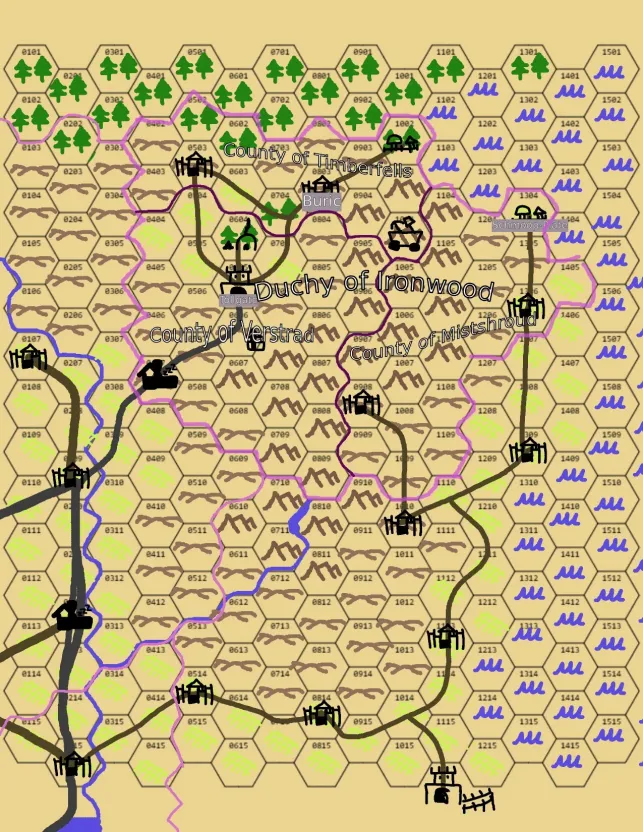
Map:
Duchy of Greycliff
This Duchy in one of several which comprise the Kingdom of Eusia. It is lead by Duke Cassian Blackwood. This duchy rests in the north of the Kingdom, it's western border is what gives it it's name; relentless, brooding cliffs overlooking the violent waters of the Western Ocean. It's north border meets the Wild North, much the same as their eastern neighbour, the Duchy of Ironwood. Though most of the southeastern border is shared with the Duchy of Marvane, there are small portions in the east and south shared with Broadwater and Vermillion, respectively.
The rainy lands, riddled with ancient ruins brimming with magic to be exploited and exported. Sometimes the rain is cursed, but the proliferation of abjuration mages from the college on the coast keeps the supply lines running and the gold flowing. Folks from Greycliff have a reputation for being odd, but their tenacity is respectable.
Exports: Magical Artifacts, Alchemical reagents, Goats cheese and Sheep wool, Cold-Weather crops
Imports: Salt, Processed flour, Tools, Woven cloth
The Duchal capital is Stormwatch, built atop great cliffs looking over the choppy western ocean.
Counties:
- County of Sunbarrow
- County of Highmount
- County of Miskaton
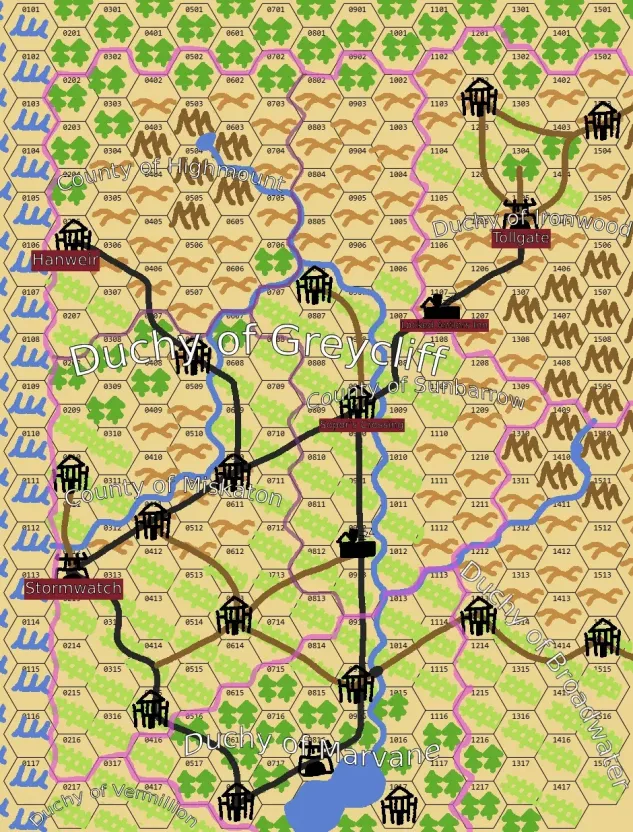
Map:
Duchy of Broadwater
This Duchy in one of several which comprise the Kingdom of Eusia. It is lead by Duchess Beatrice Marrow. It is a moderately sized duchy located on the east coast of the kingdom. It's southwest corner borders the Capital City.
Finding itself on a broad coast with plenty of natural harbors and calm seas, it is a hub of economic activity, as well as the home of the Kingdom's fledgling navy.
Exports: Processed Wool, Salt, Salted Fish
Imports: Wine, Spices, Exotic Goods
The Duchal capital is Meridia, a city dominated by it's harbor district and trade offices.
Northern parts of the continent
Regions to the north of the Kingdom of Eusia
Stormcrown Mountains
Located north of the great forests of the Wild North, the Stormcrown Mountains are an imposing physical boundary between the warm lands of the south and the open tundra of the north. They are known to be a place of mystery and increased magical activity.
This mountain range is a formidable obstacle to any traveler due to the lack of safe passes most of the year. There is a small window in high summer where the conditions become reasonably safe for prepared parties to move between north and south or vice-versa. In any conditions, straying from the path will find you in shifting glaciers, unpredictable avalanche conditions, extremely high winds, vicious snow storms, and the ever present brutal cold.
Found within the range is Skallheim Hall, a fabled place of Thor worship which is known of by the populace of the northern Kingdom of Eusia.
Frostmarch Pass
Frostmarch Pass is one of the few reliable passes through the Stormcrown Mountains. It is used by merchants travelling between the Wild North and the Tundra. It has a reputation for being deceptively calm, only to trap travelers in surprise blizzards, whiteouts, avalanches, and the rare yet terrifying lightning snowstorm.
Cosmic Mire
Located within the southern reaches of the Stormcrown Mountains, this is a holy place for the Circle of the Hrímspegill. The druids come here to stargaze and study the nature of the cosmos, and it acts for them like a temple.
Located behind a glacier which has ground the down the earth in its wake, the great ice flow has left this place behind. For a time, a lake sat between the mountains and the face of the ice, but the forward march of the glacier has since released the water, allowing many pools to form and freeze in the naturally levelled ground. Surrounded on all sides by mountains (except for the glacier to the south), the Cosmic Mire is remote and pristine. Winds sweep through this place constantly, keeping the snow pristine and erasing all trace of those who come to reflect and meditate by gazing into the mirror-like ice sheets that dot the place.
The Wild North
This region of untamed wilderness exists in northern hemisphere of the Continent of Eusia. It is the primary setting for Wild North Hexcrawl. It refers to the unclaimed pine forests to the north of the kingdom of Eusia all the way to the base of the Stormcrown Mountains. Despite this, common parlance in the kingdom is that everything beyond the northern borders of Duchy of Ironwood and Duchy of Greycliff is 'The Wild North.'
Skallheim Hall
Skallheim Hall is located deep within the Stormcrown Mountains, it's exact location known only to followers of Thor. It is an infamous place among the people of the northern duchies of the Kingdom, and many blame the residents of the Hall for bad weather which descends from the north.
The Hall is modest in size and features due to it's remote location. Also owing to this isolation, the exterior is notably less ornate than other Halls of Thunder like the famous Skyfather's Hall in the southern Donnerwald forest.. It's rugged exterior does nothing to diminish the Hall's significance to the Thorist faith, nor does it quench the warmth of it's fire, flavor of it's food, or quality of it's mead, all common qualities of Open Halls of Thunder.
Brynja Stormmantle acts as the High Keeper of the hall, residing there year round and looking after both the hall and those who find themselves within it.
Exterior: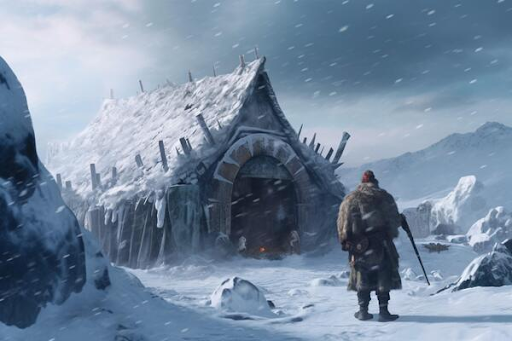
Interior: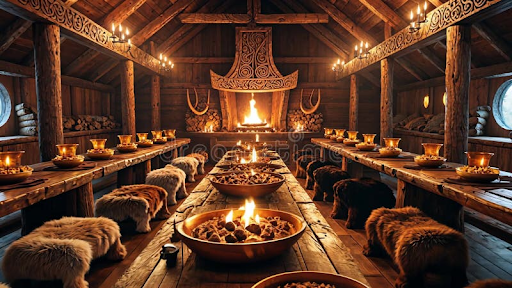
Original text:
Significance: Brynja’s Open Hall of Thunder and one of the halls that people have the most suspicions and gossip about
Description: Outside society doesn’t often hear from the storm priests that make their existence in the Skallheim Hall, and its remote location makes it unlikely this will ever change. As a result there are lots of rumors about what is and isn’t going on in this place, and whether it was the vicious and unpredictable weather that drew the storm priests to set up a hall here, or that the unpredictable weather exists because of the hall’s existence. Its exact location is only known to the followers of Thor, who travel there as part of a sacred pilgrimage they undertake but once in their lives. Many of them believe they were able to interact with divinity while up there, but whether that’s based in fact or an elaborate hallucination brought on by the sheer altitude is anyone’s guess.
Being in such a remote and inhospitable location the hall itself is quite modest in size and features. The exterior closely resembles the familiar shape of the other Open Halls of Thunder, but harsh and cold conditions require modifications to the size and exterior construction that look decidedly less ornate than Skyfather’s hall in Wolkenruh.
The humble exterior however doesn’t diminish the hall’s significance to the Thorist faithful. Nor does it diminish the functional but welcoming interior with the cozy warmth, food, and mead that’s both common to the rest of the halls as well as a necessity for the storm priest making it their (temporary) hom
The Skies' Lantern
The Skies’ Lantern sits on a rocky outcrop overlooking Frostmarch Pass, its lantern beacon is visible for miles in good weather, and often the only discernible landmark available to travellers caught in a storm on the Pass.
Description: Stormward Sanctuaries are outposts of necessity, unlike the more grand nature of the Open Halls of Thunder. As such, they generally consist of just a simple stone refuge hall with a central hearth used for both warming and sheltering the occupants as well as cooking the communal stew, stables and kennels for pack animals (depending on where the sanctuary is located), and a small shrine dedicated to Thor worship.
There are no private quarters. All who pass through the sanctuary (from its keepers to those seeking refuge) share the common hall, sleeping on simple beds arranged along its walls.
The Skies’ Lantern is very much based on this template, but the Skallheim Hall decided to add a watchtower housing the Lantern’s perpetual flame to help provide visual guidance in the often challenging conditions of the pass.
Exterior (flavour picture):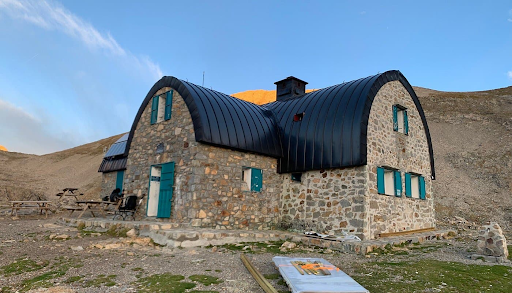
Factions
Dalaichin Nomads
These former Drow elves live on the Eastern Ocean and Western Ocean upon great Crystal Ships. Their society is ocean-faring, and they have no known land-based settlements. As a result of their unique history, they cannot cast spells in the traditional sense. Instead, they have adapted a great number of different techniques to accomplish many of the same feats without the use of spellcasting.
They are known to the people of the mainland as secular and insular traders who never shy away from a good bargain. If luxurious and exotic wares are what you desire, wait in a port for the Dalaichin Nomads to arrive.
Within their own society, there is a healthy culture of sharing the wealth. When someone on the ship nets a generous profit, all aboard are likely to see a portion of the benefit. That being said, private property is a healthy concept, and Dalaichin elves are fond of displaying unique and exotic clothing and accessories to showcase their shrewd trading skills.
Each ship is organized such that there is a ruling council that decides together how to best spend the public wealth. The three masters are:
The Master of Harvest sees to incoming supplies and their rightful distribution among the population, usually through purchasing goods in ports and supplementing them with the bounty of the sea. They are focused on the health of the people, but also on the health of the ship. They see to repairs and maintenance, as well as to the tertiary vessels that the ship keeps. Superstition says that it is bad luck for a Harvest Master to set foot on dry land, as that is when the ship will call for their attention.
The Master of Wealth attends to the raw profit brought in by the purchase and sale of trade goods. It is this master's responsibility to learn of the markets in as much of the world as can be reached by the ship. Because of this, they will often cultivate a healthy network of eyes and ears on the mainland to learn what to purchase and what to sell in each port. This also lends them to the secondary role of spymaster, ensuring that the interests and reputation of their ship, as well as Dalaichin Nomads as a whole, are well represented. They will also sometimes dispatch agents as spies or diplomats to smooth over tensions which would disrupt trade and interrupt the flow of profit.
The Master of Crystals is in charge of all magic aboard the ship. Dalaichin elves are unable to cast spells themselves, meaning that scrolls, potions, wands, staves, rods, and all other magical items are especially precious to them. This master also attempts to cultivate Mana crystals, though it is rare that they will succeed in creating a seed that bears a meaningful yield. They ration out the stockpile of Mana crystals that they acquire from their trips back to the Mother Ship, ensuring that the fuel needs of the ship are met without running dry.
Counter to this council is an executive branch comprised of the Waveseeker, or navigator, and Wheelmistress, or captain. Traditionally both roles are reserved for women, a holdover from the older Drow culture. They work to make a plan of movement and action for the ship as a single entity. Though the Council is in charge of material and as such have a tremendous amount of sway, the Wheelmistress can veto any decision on the ship, and her word is law.
Not all Dalaichin Nomads bind themselves to the great ships, however. Some find work as couriers on their own vessels, then end up working exclusively with outsiders. Sometimes that work even takes place on land. Sometimes, an agent of a Harvest Master finds a place to their liking and bids farewell to their shipmates. Additionally, the long life of an elf gives lots of time to master many skills, and those who wish to ply their trade without the prying of other Dalaichin may take to the mainland to do so. Those who leave their ships are not outright banished, but it can be difficult for a 'land-tainted' Dalaichin to regain the comradeship of their shipmates if they come back.
The Still Chain
A religious order who worship Helm and oppose the Thorists who see them as the cause of violent storms and a dangerous sect who must be silenced or controller. They have been known to dismantle storm shrines, attack the Thorist halls, imprison storm clerics and paladins, and are working to get our the Thorist order outlawed for being “uncontained threats”.
The ledger of the calm seas
The combined power of the eastern coast’s shipping guilds who are bankrolling groups like the Still Chain, in hopes of silencing storm worship out of fear for their business model. The ledger couldn’t care less about the religious differences between the Thorists and the Chain, they simply believe that once storm worship gets outlawed they will never lose another ship at sea, and that’s all they care about - the bottom line.
Zaharan (Tabaxi) Tribes
Zaharan tribes generally form the basis for the small settlements found across the harsh region, with each town headed by an elder who operates as the figurehead and chief of the town.
Tabaxi Elders are not officially recognized by the Crown as figures of authority in the Crown -> Duchies -> Counties -> Baronies structure, but function as voices of authority within the tribes and villages of the Zahar.
Due to the remote nature of the region they are allowed to effectively self-govern within the structure of the kingdom. Royal authority is of course still present in the form of tax collectors, and there is both legal and enforcement precedent for the Crown upholding trade agreements if the situation calls for it.
Tabaxi trade caravans
Trade caravans occupy a central place in Zaharan society. While many Tabaxi live in permanent settlements such as Ri'shara, the vast distances between communities and the culture's long-standing tradition of travel have given rise to a network of small caravans that crisscross Eusia. Caravans carry goods, news, stories, maps, and introductions between distant peoples, serving as merchants, messengers, and cultural ambassadors all at once. For many young Tabaxi, joining a caravan is considered a rite of passage and a chance to satisfy their curiosity, earn a living, and bring new knowledge home.
Most caravans consist of five to six Tabaxi, large enough to defend themselves and manage their pack animals, yet small enough to travel quickly and adapt to changing conditions. Each member typically fills a specialized role, such as leader, trader, scout, guard, healer, storyteller, or apprentice, though experienced caravaners are often expected to help wherever needed.
Zahari trade caravans are such a reliable and dependable network of goods transport that they form the Eusian continent’s largest over land distribution system of goods. Either you sell your goods to a caravan (who will sell it on with a healthy profit) or hire them to deliver your goods to your customer. Their utility is so renowned that most people know that “Unless you can send it by ship, it will have passed through Zahari hands”.
Esmeralda’s Gold
Ganso’s mafia of legitimate business.
Don: “Baron” Francesco Ganso
Motivation: to capitalism his way to nobility through business ventures
Assumptions: Gnomes are generally money hungry/capitalist at least in this setting - perhaps it is a stereotype (if anyone who plays a gnome that isn’t like that or other NPCs)
Business Ventures:
-
The Gander & Goose Public Houses chain
- The Baron’s Feather-Fine Ingredients (where the ingredients for the Gander & Goose Public House are sourced from)
Malakyzia’s Right
The River Pirates of Eusia - Idea
Based out of the Duchy of Marvane given the rivers and lakes and access to the capital.
Feared by those who navigate the rivers in commerce, trade, or simple means of navigation avoiding the terrain.
Imagine siding or striking a bargain with these pirates.
Do they trade in stolen goods, trafficking beasts, magical wares, or something darker like a monster or slave trade?
Their boats bear the flag of the Eusian coat of arms crossed out with staunch white bones as they are anti-monarchy. One of their core tenets is to overthrow King Alden XV and install their “Empress” Captain Malakyzia Wavelocke.
On our way to kill Alden our greatest foe, who interrupts our path to glory, to install our rightful ruler the Empress Wavelocke Malakyzia.
Ships
Depending on the width of the river their ships might be more narrow, similar to riverboats.
History and lore
Origins of the Dalaichin Nomads
Originally, they were like any other Drow from the Deep Dark. Centuries ago, they were cursed by Lloth, losing all access to the power of magic. Seen as heretics, their Lloth-favoured cousins chased them out. Finding themselves in a harsh tundra, a surface world which saw them with an equal unkindness as their former brethren, and without the aid of magic, they set about making their way in this new world. They were led by 3 sisters: Sejanus, Garviel, and Tarvitz.
Each inhabited place they came to saw them as enemies, and without magic to speak a common tongue, they were unable to make more than passing attempts at diplomacy. In those dark early days, they were night raiders on the small gatherings of Human and Orc wildlings which make their home in the north. It was not until a bold (or foolish) attempted raid on a Dwarven hold that their fortunes turned.
The Dwarves of Kharad Norn kept watch over the tunnels that led to their home from below, but they almost always expected attacks from the surface. After yet another failed Orcish raid, they sang to victory in their mead hall. When the alarm was raised yet again, it was with surprise that they encountered a poorly armed, near-starving group of Drow. Being on the border of the Deep Dark, they spoke Deep Common. Despite the cultural enmity of their people, Tarvitz was desperate enough to beg mercy and aid, and the Dwarves, both recently cheered by victory and sensing opportunity (the enemy of my enemy), provided.
In the next months, the Nornish Dwarves and the Outcast Drow pooled their knowledge, seeing mutual benefit. The Drow taught the Dwarves about the Deeper Dark and how to plumb its resources safely. The Dwarves taught the Drow of Runic Magic. Sejanus was particularly keen on this new magic. Effectively alchemy, but with a solid product rather than a liquid, it allowed the Drow to create minor magical items. The Dwarves also let the Drow make use of their forges, and their proficiency in metalwork expanded. Garviel set to work creating hunting tools such that she and the others would be able to provide for themselves.
When the time came for the Drow to depart, they did so as friends. This cemented a part of the identity of this fledgling culture, differentiating them from their Deep Dark cousins: a willingness to earnestly and honestly cooperate with others. They also learned a version of the common tongue to better work with those they would find on this surface world.
The Drow struck out into the cold north in Spring, hoping to use their new tools to make a better home. The sunlight still stung their eyes, but they kept looking. More and more, they were fashioning new tools, clothes, and equipment from the animals they hunted and the places they camped. Still, most others did not trust them, so they did not move toward the Kingdom of Eusia to the south. Instead, they moved from place to place, following an Auroch herd and taking kills from it whenever they could manage.
One hunting day in the autumn of the same year saw an immense opportunity. With the crush of winter threatening any day now, the Exiles sought to take as many aurochs as they could. The opportunity was a simple one: a glacier with a massive cleft. If they could force a portion of the herd over the edge, they could trap them, harvesting those who died in the fall and potentially capturing any who survived.
As they lay in wait to spring their ambush, they felt the glacier shift slightly. Concerned but unable to notice any difference, they proceeded to enact their plan. Rune Magic clappers and spark throwers startled the aurochs in the right direction, when suddenly the glacier burst open, a huge ice elemental standing menacingly between the Drow and the herd. For a tense moment, they waited for it to attack, but no assault came.
Unwilling to charge the huge elemental and risk any of their meagre number, the Drow watched achingly as their quarry slipped away. The elemental spoke to them, saying that they had already taken enough from this herd. Garviel proclaimed that without the aid of meat, bone, and hide from these beasts, her people would not survive the winter. The elemental agreed; without aid, they would perish, and then simply vanished.
Dismayed, the hunters returned to camp, prepared to share news of their impending doom. Instead, they found the fire stoked higher than ever, a roaring bonfire, around which human shamans danced. Fire elementals danced in the flame, air elementals ran through the trees, water elementals melted snow into clean water, and earth elementals formed sturdy, low huts around the fire.
Tarik explained to the hunters that these shamans had seen them depart toward the herd, and knew from the fashioned equipment that these Drow had respect for the nature they were living in. He went further, saying how these shamans had agreed to teach the Drow how to survive the winter by working with the elements if they agreed to leave the beasts of the land alone. Seeing no other way forward, Garviel agreed. Sejanus was easy to sway, as working with elementals meant new ways to interact with the magic she so desperately missed.
By the end of the winter, the Drow had learned much about the elementals of the land and came to form close ties with the shamans. It was the head Shaman Falkus who, in passing, gave a new name to these Drow. He had remarked how easily they sailed through this harsh winter, but in his people's private tongue. The word he had called them, Dalaichin, stuck.
The following winter, Garviel's son, Loken, dishonoured his mother. Finding himself old enough now to provide for the Nomads, he sought to procure a rare treat for them all: meat. He struck down an auroch with his javelins and spear, and hauled the beast back on his own, no small task. At the sight of the slain beast, the three sisters knew that the elementals of this land would not heed their call any longer, for the accord had been broken. Loken did not apologize, and instead proclaimed that this way of living on the surface was not possible. Lloth had damned them, and they would all surely perish.
Knowing that they would not survive in this land without elemental aid, too far from the dwarf hold to ask for refuge, and knowing that the south would not accept them, the brothers moved their people to the only place they could: the coast. With the accord already broken, they took as many large animals' lives as they could, fashioning what they needed from their bodies. By the time they reached the ocean, the crafty Nomads had what they needed to get started.
A great Runic ritual was constructed. Without any magical ability among them, it was all based on alchemy and runic magic. To power it, they would have to make a sacrifice of great magnitude. Though Garviel protested dearly, her sisters took their nephew into the ritual, and pleading with the elemental spirits, they sacrificed him. His blood bound a great water elemental and several earth elementals. Together, they formed a tightly knit fleet of vessels wrought of living stone barely large enough to hold all the elves. In her grief, Garviel could not join them, and the last of her that any Dalaichin saw was on that black sand beach in freezing winter holding the still warm body of her boy.
That winter was immensely difficult. On a frozen sea with little cover from the elements, they hunted seals, whales, and fish. Little by little, they expanded their vessels, adding structure and facilities. As if the salt and ice of the sea came together with elemental magic, the stone vessels began to change from stone to crystal.
By the time summer had arrived, life was a little easier. Sejanus tended to the runic devices, carving new runes when needed and iterating on them little by little. Tarvitz coaxed the earth elemental into transmuting animal parts into paltry quantities of metal, which she was eventually able to make into tools. Little by little, piece by piece, the first ship of the Dalaichin Nomads took shape.
Years later, the vessel was no longer made of stone, but of metal and crystal. The buildings upon it were small but efficient, and a proper economy of food, clothes, weapons, tools and the like had formed. Smaller boats were common, and it was common for the Dalaichin to venture forth into the ocean in search of goods to bring back to the ship. With their exotic goods, they often found good trade with Human vessels when they happened upon them. The Humans, for their part, found it difficult to believe that a Drow in furs on a boat in the ocean could be a spy from the Deep Dark, and so were more trusting.
The troubles were not over, however. The water elemental they had bound had demanded a price for its continued service: fresh sacrifices. At first, it was a single soul on the anniversary of Loken's death. Then a soul at each solstice. And then also the equinox. Then it was two each time. The elemental's hunger grew and grew, but without its power, the ship would plummet into the ocean, and they would all perish.
After years of this terrible bargain, Sejanus made a breakthrough. Perhaps because they were so far away from any other people, and none amongst them were using the magic in the area to cast spells, the place around their ship was always engorged with mana. Using runic magic, as well as a prototype cobbled together by Tarvitz, she was able to capture mana from the very air and condense it into a tiny crystal. The crystal grew as mana agglutinated to it. It would prove to be revolutionary for Dalaichin culture.
The crystals grew fast enough to appease the elemental's hunger and accumulate a small supply of the valuable resource. Eventually, Sejanus found a way to summon a new elemental using only the crystals, and the Devourer was sent back to the plane of Water, full of the energy of a hundred souls.
It is from there that the story goes. After centuries of expansion, the original vessel remains in the North Ocean, home to Five thousand elves. This Mother Ship serves as the base for all the other Crystal Ships, of which there are 3 known to the world, each holding one thousand souls. They still fish and hunt, but their days of survival by the skin of their teeth are behind them. Shrewd in the ways of Runic Magic, Elemental bargaining, and the art of crafting, they sell their wares and make a good profit doing so.
Open Halls of Thunder
The Open Halls of Thunder are the spiritual centers of the Thorist faith. Part temple, part refuge, part school, and part community gathering place, they serve as places where followers of Thor worship, learn, debate, feast, and seek shelter beneath the open sky. Despite sharing common traditions, the Halls are independent institutions rather than branches of a centralized church. Each Hall governs its own affairs, interprets Thor's teachings in its own way, and is led by its own keepers and clergy.
The Halls are united by a handful of shared principles, foremost among them the Law of Open Doors, which requires aid and hospitality be offered to those in need regardless of station, origin, or belief. Many Halls also contribute resources and personnel to the Stormward Sanctuaries, reflecting the faith's belief that those who wield the power of storms bear a responsibility to assist those affected by them.
Open Halls vary greatly in size and influence. Some are little more than modest frontier lodges maintained by a few devoted priests, while others attract pilgrims and scholars from across Eusia. Regardless of their scale, all Open Halls share a common purpose: to teach courage in the face of hardship, provide shelter during life's storms, and honor Thor through service as much as worship.
Stormward Sanctuaries
Stormward Sanctuaries are practical outposts maintained by followers of Thor to provide refuge, rescue, and relief in places where storms and the natural world pose a constant danger. Found along mountain passes, remote roads, coastlines, wilderness trails, and other hazardous routes, they serve as waystations for travelers and safe havens during severe weather.
Unlike the Open Halls of Thunder, Stormward Sanctuaries are not centers of worship or learning. Most consist of little more than a refuge hall, stables or kennels, basic stores of food and supplies, and a small shrine open to the sky. Their keepers spend far more time monitoring weather, guiding travelers, organizing search parties, and aiding disaster victims than performing religious ceremonies.
The sanctuaries embody a core Thorist belief: those who benefit from the power of storms bear a responsibility to help those harmed by them.As public suspicion of storm magic has grown throughout Eusia, the Stormward Sanctuaries have become both a symbol of the faith's commitment to service and a reminder that courage is measured not only in battle, but in helping others weather life's storms.
The Sapphire War
The Sapphire War was fought between the Kingdom of Eusia and several powerful desert city-states that controlled the largest known deposits of sapphirite, a rare crystal prized for its ability to conduct and amplify magical energy. As demand for the crystal grew, disputes over trade rights, mining claims, and control of key caravan routes escalated into open conflict. What many initially expected to be a short campaign instead revealed just how advanced the desert powers had become in combining magic, engineering, and warfare.
The war reached its turning point at the Battle of Glass Winds, where a major Eusian offensive was halted by experimental desert weaponry. Using enormous crystal mirrors and sapphirite-based devices, the city-states disrupted battlefield communications, disoriented advancing troops, and shattered the kingdom's momentum. Though neither side emerged with a decisive victory, the battle effectively ended Eusian hopes of controlling the sapphirite trade by force.
To this day, the Sapphire War remains a symbol of the dangers of underestimating the desert city-states, and countless families across Eusia still remember relatives who never returned from the fighting.
The Gander & Goose Public Houses
Owner: “Baron” Francesco Ganso
Logo: Snow Goose with tufty feathers sticking out of its head similar to Francesco, with a monocle, cane in wing.
Branding:
Consistency is key at the Gander & Goose, all in-house beverages and signature ingredients come from the Ganso Barony - shipped in by the week - always ensuring the finest quality ingredients.
Signature Beverages:
Gandale: a smooth medium-bodied ale aged in the finest oak barrels infused with pear wood and a hint of cinnamon.
Golden Goose: honey infused premium mead with a velvet texture from sunshine honey that evokes the feelings of honey bees midsummer, right in the Baron’s own apiary. Topped off with a tinge of honeysuckle delight.
Goose Feather (Non-Alcoholic): drift in the clouds, chilled milk swirls with flavours of flavours of mint, vanilla, or coffee. Whisked into a blend of cream and milk and arcane ingredients for weightless quality. Perfect for those wanting delight without the intoxicating aftermath. Great for those that prefer a fun beverage without the side effects. May induce feelings of a slow descent.
Potion of Featherfall - short duration
All signature beverages come with a Gander & Goose signature goose head tankard and topped with a Snow Goose feather plucked from the Baron’s own aviary.
Gods, Deities, and Greater Powers
All who are feared, revered, and worshipped by the people of Eusia
Tiamat
Tiamat was the Evil God of Chromatic Dragons. Her portfolio included Conquest, Trickery, and Avarice. Generally, she was thought to be imprisoned in Hell.
The Lady in White
The Lady in White is a minor deity associated with the village of (cool mountainous village). She is a benevolent undead entity which looks after the souls of the village, both in life and in death. She is a goddess who exists regularily in her follower’s daily lives, though she is bound to the village and so can only bless them while they reside there.
It is by her hand that the Clergy in White raise the dearly departed into zombies. As the clumsy beginning of their journey commences, they are suited mostly to field work and non-dexterous manual labor. They do not yet remember anything of their past, and it is The Lady who keeps them content. As their flesh rots away to reveal the skeleton underneath, they begin to recall their past and may begin to recognise family and friends. One’s Second Life usually plateaus for some time in the skeletal stage, and they are the most common Returned within the village. More cognisant and dexterous, skeletal Returned perform all sorts of tasks from weaving to threshing, basically anything that a child could accomplish. They are not yet wise enough for planning and logical tasks. The Clergy diligently cleans Skeletal returned to keep them from introducing and odor or disease to the First Life villagers.
The Lady in White wishes for all her children to lead virtuous lives, for it is the accumulated positive energy of a soul that allows a Returned to linger for longer. Sinners may cease their second life without ever rotting enough to expose bone, while Saints will endure while even the smallest sliver of their skeleton remains. Deep within the Crypts of Remembrance, wise spirits of the elders remains attached to fragmented skulls and fingers. The purest form that a Returned can achieve is that of full spectral presence, wherein they not only recall everything from their life, but can learn new information. Legend holds that the oldest Spirits, members of an advisory council to the living Baron, are centuries old.
The Lady is unique in that she no longer possesses any physical body, only an ornate casket which once held her in repose. So old is she that it is said she remembers the previous empire and what befell it, though she refuses to speak of those dark days.
Sune
Sune in the Lore of Eusia
Sune was the Lady Firehair, a radiant goddess of love, beauty, passion, and sensual pleasure. Her faith treated beauty not as vanity, but as a sacred force that made life worth living, and her worshippers often honored joy, romance, art, and personal allure as divine gifts.
Portfolio and Names
Her portfolio included love, beauty, passion, and often the celebration of physical and emotional attraction. She was commonly known as Sune, Lady Firehair, and in many traditions she was associated with red-gold hair, warmth, and irresistible charm. Her presence in lore was usually tied to romance, inspiration, elegance, and the courage to love openly.
Who Prayed
Sune was often prayed to by lovers, artists, poets, courtiers, performers, and anyone seeking confidence or grace. She also drew prayers from people hoping to recover from heartbreak, inspire attraction, mend relationships, or simply feel beautiful in their own skin. Those who honored her rarely treated devotion as solemn suffering; they treated it as a joyful affirmation that pleasure and affection could be holy.
When They Prayed
Her worship was often strongest at dawn, at festivals, before dances, during courtship, and at moments of personal transformation. Many of her followers would have prayed before art, performance, romance, bathing, dressing, or any event where presence and charm mattered. Unlike gods of hardship, her faith tended to favor bright, public, celebratory moments.
Holy Day and Devotion
A fitting holy day for Sune was often celebrated with feasts, music, flowers, candles, perfume, dance, confession of admiration, and declarations of affection. Her observances commonly centered on spring, midsummer, or any local festival devoted to beauty and union. In practice, every act of sincere delight could have served as an offering to her.
Ways of Praying
One way to pray to Sune was through praise: speaking aloud the beauty one had seen or the love one wished to protect. Another was through ritual preparation, such as dressing carefully, adorning a shrine with flowers and ribbons, or creating something beautiful in her honor. Her faithful often believed that the act itself mattered as much as the words, because devotion to Sune was meant to be felt in the body as well as the heart.
Shrines and Temples
Shrines and temples of Sune were usually vivid, fragrant, and welcoming, often decorated with mirrors, silks, petals, polished metal, carved figures, and warm light. They were typically spaces where music, conversation, art, and intimacy were not merely allowed but encouraged. In many places, her temples doubled as gathering halls, salons, or places where the lonely could find companionship and the shy could learn confidence.
Clergy and Organization
Sune’s clergy tended to be socially graceful, persuasive, and deeply involved in community life, especially where art, courtship, or social mediation were concerned. Her priesthood often included performers, counselors, diplomats, beauticians, and teachers of self-presentation. Rather than a stern hierarchy, her religious organizations usually felt like circles of patrons, attendants, and beloved figures who maintained shrines, hosted gatherings, and nurtured joy. Some clergy members of Sune’s church were not unlike geisha.
Church Character
The Church of Sune was likely remembered less for rigid doctrine than for atmosphere: warmth, welcome, elegance, and emotional honesty. Her faith could have defended romance against shame, beauty against cruelty, and pleasure against puritan fear. At its best, it reminded people that tenderness, attraction, and delight were not distractions from life, but part of what made life worth defending.
Summary
Sune could be summarized as the goddess invoked when beauty needed protection, love needed courage, and joy needed permission to exist openly. Her faithful did not merely seek pleasure; they sought the kind of beauty that made hearts braver and lives more radiant.
Ilmater
Portfolio and Names
His core portfolio was endurance, suffering, martyrdom, and perseverance, and the relief of the oppressed. His faithful treated pain not as a curse to be glorified, but as something to be carried for the sake of others. He was known by many titles in the old lore, including the Crying God, the Broken God, the Lord on the Rack, and the One Who Endures. In some traditions he was also called Ayuruk among the peoples of the Great Glacier.
Who Prayed
Ilmater was chiefly prayed to by the lame, the poor, the oppressed, the persecuted, monks, paladins, serfs, slaves, healers, and those living under unjust hardship. He was also especially honored by people who worked to lessen suffering directly, including those who cared for the sick, the wounded, and the homeless. His worshippers often saw him as the god who helped them endure, while also teaching others to shoulder suffering on behalf of the helpless.
When They Prayed
Clerics of Ilmater prayed for their spells in the morning. Older devotional practice described ritual prayer repeated many times through the day, sometimes six times or more. That made his worship feel steady and rhythmic rather than centered on a single dramatic hour.
Holy Day and Devotion
One common tradition recorded that Ilmater had no annual holy days, which fit the idea that his faith was expressed more through continual service than calendar festivals. In practice, that meant acts of mercy, vigils, healing, and self-denial often mattered more than public celebration. If a local tradition needed a formal observance, it usually took the shape of a day of fasting, alms, healing, or remembrance rather than revelry.
Ways of Praying
One well-known prayer form asked Ilmater to look upon the speaker’s weakness, accept their fault, and grant them endurance to carry what must be borne. Another common devotional pattern was simpler and more practical: a cleric prayed while binding wounds, feeding the hungry, or sheltering the sick, treating the work itself as prayer. The faith’s emphasis on service meant that prayer and action were rarely separated.
Shrines and Temples
Shrines and temples of Ilmater were often found where suffering was greatest, especially among the poor, the sick, and the displaced. His houses of worship commonly served as hospices, shelters, healing centers, and places of refuge, with clerics distributing food, drink, firewood, medicine, and comfort to those in need. In larger cities, his worship spaces could also be embedded in more formal temple complexes and charitable institutions.
Clergy and Organization
His clergy were commonly called the Adorned, or more formally the Adorned Sufferers. Within that clergy, some traditions distinguished healers, painbearers, and sanctars, with sanctars serving as the highest and most secretive rank, acting as judges, investigators, and protectors of the faith. The wider church also included monastic orders and knightly orders, such as the Broken Ones, the Order of the Golden Cup, the Companions of the Noble Heart, and the Weeping Friars, among others.
Church Character
The Church of Ilmater was described as a broad religious organization dedicated to service, mercy, and the reduction of suffering. Its clergy were known for charity, discipline, and self-sacrifice, and its internal structure mixed monastic life with organized orders of healers and warriors. In some regions, especially in major urban centers, the clergy formed a highly organized and influential network that could shelter the poor, oppose slavers, and defend those who could not defend themselves.
In Summary
Ilmater was the god invoked when pain could not be avoided, but meaning still had to be found in it. His faithful did not merely pray to survive; they prayed to endure, to heal, and to become shelter for others.
Gam Gam
An Archfey who weaves fate as easily as she knits yarn. Patron to those who find themselves caught in destinies strands, she works to guide these poor souls towards glorious achievements. She is kindly, abhors destruction, and enjoys a good joke with a cup of hot tea.
Aurel Veyr
Aurel Veyr is a minor deity associated with Helm. Seen as his son, Aurel Veyr takes the stern protection of his father and turns it inward, keeping a hearth and home which is worth protecting. Different from Chauntea in that he does not provide for families, Aurel Veyr is concerned with the disciplined keeping of internal order within rough places. Helm is the external defense, Aurel Veyr keeps everything inside from coming apart.
The faithful give prayers to Aurel Veyr when they perform duties of stewardship, taking oaths, safekeeping, and supporting rightful authority. As Aurel Veyr serves his father Helm, adherents of Aurel Veyr often serve others themselves, making his worshipers likely to become stewards, chaplains, and other types of support staff for nobles and powerful merchants.
Thalor
Neutral god of the sea as well as what lies beneath its waves 
Lloth
Also known as the spider queen.
Chaotic evil goddess of the Drow. Real piece of work.
Thor
Portfolio and Names
Thor is the god of thunder, storms, strength, courage, protection, war, and the open sky. To his followers, he is not merely a god of battle but a protector who teaches that strength exists to serve others. He is commonly known as the God of Thunder, the Thunderer, Skyfather, Guardian of the Heavens, and Thor the Mightiest. His faith teaches that storms are neither inherently good nor evil; they are powerful, disruptive forces that must be faced with courage and respected with humility.
Who Prayed
Thor's faithful come from all walks of life. Warriors seek his blessing before battle, sailors before dangerous voyages, and travelers before long journeys. Farmers pray for favorable weather, hunters for endurance, and ordinary folk for the courage to persevere through hardship. His worship is especially popular among frontier communities, caravaners, explorers, riverfolk, and those whose lives place them at the mercy of the natural world.
Many of Thor's followers believe that bravery is not the absence of fear, but the decision to act despite it.
When They Prayed
Thorists traditionally greet the dawn with prayers for strength, courage, and wisdom. Prayers are also commonly offered before battle, before setting out on a journey, during storms, and whenever a person faces a difficult task or moment of uncertainty.
Thunder is often regarded as a reminder of Thor's presence, though his faithful are careful not to claim that every storm originates from divine intervention or mortal storm magic.
Holy Day and Devotion
Thorist devotion is highly communal. Feasts, storytelling, contests of skill, athletic competitions, and displays of courage are among the most common forms of worship. Acts of service are equally important. Rebuilding after a flood, helping a community recover from a storm, or sheltering travelers in distress are considered expressions of faith no less meaningful than prayer.
The faith places great importance on the principle that power carries responsibility. Strength is celebrated, but only when used to protect rather than dominate.
Ways of Praying
Thorists favor direct and honest prayers. Worshippers commonly ask for strength of arm, courage of heart, clear judgment, and the resolve to endure hardship. Many prayers are spoken beneath the open sky, reflecting the belief that one should never completely separate oneself from the world Thor governs.
Some followers offer prayers through action rather than words, performing difficult labor, aiding others in times of crisis, or facing danger willingly in service to their community.
Shrines and Temples
Thor's faith has no central church or supreme authority. Instead, it is organized around independent Open Halls of Thunder, each governed by its own keepers and clergy. These halls serve as places of worship, learning, hospitality, and debate. Though they cooperate frequently and share many traditions, no Hall holds authority over the others.
One of the faith's most sacred customs is the Law of Open Doors, which compels Thorists to offer shelter, aid, and hospitality to those in need.
To help fulfill this duty, many Open Halls support a network of Stormward Sanctuaries located along dangerous roads, mountain passes, coastlines, and wilderness routes. These sanctuaries provide refuge during storms, organize rescue efforts, assist disaster victims, and teach the responsible use of storm magic. Their existence reflects a core belief of the faith: those who wield the power of storms bear a responsibility to help those affected by them.
Clergy and Organization
Thor's clergy include priests, storm clerics, paladins, weather-watchers, scholars, and wandering champions. Leadership is earned through service, wisdom, and proven deeds rather than strict hierarchy. Clergy are expected to remain engaged with the world, helping their communities and confronting danger when necessary.
Because the Open Halls operate independently, theological disagreements are common and often encouraged. Debate, discussion, and differing interpretations are viewed as signs of a healthy faith rather than evidence of division.
Church Character
Thorism is characterized by courage, honesty, hospitality, responsibility, and resilience. Followers are expected to face hardship directly, defend those who cannot defend themselves, and accept the consequences of their actions.
The faith also acknowledges a growing tension within Eusian society. Many people fear storms and increasingly associate storm damage with Thor's followers. As a result, Thorists often find themselves balancing the use of their divine gifts with the need to demonstrate wisdom, restraint, and accountability. This challenge has become one of the defining issues facing the faith in the modern age.
In Summary
Thor is the god people invoke when the storm arrives and retreat is no longer an option. His followers do not pray for a life free from hardship; they pray for the strength to endure it, the courage to face it, and the wisdom to help others through it. To them, the storm is more than a symbol of power—it is a reminder that the greatest measure of strength is what one chooses to do with it.
Faiths, religions, and superstitions
Things people believe (that may or may not be related to the gods)
Zodiac Signs
- Drakon, The Draconic Star
A blazing crimson constellation said to burn with the spirit of dragons. It shines brightest during times of conquest and great change. Those born beneath it: Ambitious, determined, proud, and driven to leave their mark upon the world. They rarely settle for mediocrity and possess an intense inner fire. ⸻
- Wandelin, The Roaming Star
Unlike every other star, this wandering light never remains in one place for long. In some lands it is visible for weeks, while in others it vanishes entirely before reappearing elsewhere. Those born beneath it: Carefree, adventurous, spontaneous, and impulsive. They chase new experiences, dislike routine, and often trust instinct over careful planning. ⸻
- Gemel, The Twin Star
A pair of stars that appear as one from afar, forever circling one another. Their light shifts constantly, making it difficult to tell which shines brighter. Those born beneath it: Adaptable and multifaceted. Their personalities shift with circumstance, allowing them to embody strengths—and weaknesses—found among many of the other signs. ⸻
- The Dark Star
This star gives no radiant light, instead appearing as a dim void against the heavens. Though overlooked by many, its presence is unmistakable to those who know where to look. Those born beneath it: Calm, disciplined, introspective, and reserved. They are patient observers, often carrying a brooding demeanor while possessing remarkable self-control. ⸻
- Solis, The Dawn Star
A brilliant golden star whose warm light is said to bring hope to travelers and comfort to the lost. It is among the brightest lights in the night sky. Those born beneath it: Energetic, compassionate, optimistic, and deeply empathetic. They naturally inspire others and often place the needs of loved ones before their own. ⸻
- The Stagnant Star
This star appears fixed even as the heavens turn around it. Ancient astrologers claimed that nothing could move it from its course. Those born beneath it: Resolute, steadfast, and dependable—but often stubborn. Once they have chosen a path, changing their minds is nearly impossible. ⸻
- Arcanis, The Arcane Star
A luminous star that glimmers with shifting shades of violet, magenta, and blue. It has long been associated with the Weave and unexplained magical phenomena. Those born beneath it: Curious, imaginative, intelligent, and naturally drawn toward magic and mystery. Their minds constantly seek knowledge beyond the ordinary. ⸻
- Noxis, The Fractured Star
Rarely seen, this pale white star appears cracked, as though its light has splintered into jagged pieces. Despite its broken appearance, it has never faded from the heavens. Those born beneath it: Resilient, unconventional, and quietly enduring. They often carry emotional scars yet find strength through hardship, seeing beauty where others see only ruin.
South of the kingdom
The vast desert that splits the continent in half, and everything south from there.
The Zahar
The Zahar sits south of Summervale on the eastern seaboard of the continent and next door to the vast central desert. As such, it forms the semi-arid region that separates heartlands of the kingdom of Eusia from the harsh deserts that belt the continent around the planet’s equator. It’s the native ancestral ground of the Tabaxi and home to various small tribal settlements. While operating semi-independently due to lack of government enforcement, the Zahar contributes to the overall prosperity of the kingdom by facilitating the transfer of overland goods through their caravans, and its defense through the fierce warriors the kingdom can call on in times of conflict.
Description: Zahar means “golden” and it’s a most fitting reference to the region as a whole. From the golden grass of its steppes to the beautiful sunsets native to the region.
The semi-arid nature of the region makes it poorly suited to large-scale agriculture. While the Zahar contains valuable resources such as precious stones and metals, most major extraction efforts are controlled by outside mining corporations that funnel wealth out of the region while providing limited benefits to local communities.
As a result, many Zahari live modest lives centred on hunting, gathering, herding, and survival in a demanding environment. This harsh upbringing is also one reason the region has a reputation for producing some of the kingdom's fiercest warriors, a fact the Crown readily remembers whenever it must raise armies during times of conflict.
For those not looking to scrape a meagre living off the land or fighting for their survival, the only other viable profession is to become a trader. In fact, Zahari trade caravans are such a reliable and dependable network of goods transport that they form the Eusian continent’s largest over land distribution system of goods. Either you sell your goods to a caravan (who will sell it on with a healthy profit) or hire them to deliver your goods to your customer. Their utility is so renowned that most people know that “Unless you can send it by ship, it will have passed through Zahari hands”.
And while some may look at the Zahar and wonder why anyone would want to live in a place that harsh, to those who were born there or who still call it their home it’s one of the most beautiful places in the world with unique flora, fauna, and opportunities.
Ri'Shara
Ri'Shara is a small settlement in The Zahar, but of great importance to both the Tabaxi and overland trade in the kingdom as the coordinator of the caravans (Nadira-who-Remembers) lives here.
It is known in the Tabaxi dialect as the "Place of Returning," Ri'shara is one of the oldest settlements in the Zahar and a cultural centre for the region's Tabaxi communities. Built around a permanent spring, it serves as a gathering place for nearby settlements and a departure point for many of the trade caravans that crisscross Eusia.
The settlement is home to Nadira-Who-Remembers, a respected elder responsible for coordinating caravans, preserving local traditions, and maintaining ties between distant communities throughout the Zahar.
Ri'shara exists because of water. Generations of Tabaxi settled around the spring at its heart, creating a permanent refuge within an otherwise harsh land. Unlike the towns and cities of the kingdom, Ri'shara has no walls, grand buildings, or formal streets. Clusters of homes, animal pens, market stalls, and communal shelters surround the spring before gradually giving way to the grasslands beyond.
Ri'shara is rarely quiet. Caravans arrive and depart throughout the year, bringing news, stories, and goods from across Eusia. Their return is often a community event, with friends and family gathering to exchange gifts, settle accounts, hear tales of distant lands, and welcome travelers home. While the settlement remains predominantly Tabaxi, merchants, craftsmen, laborers, and other travelers from across the kingdom are a common sight.
To outsiders, Ri'shara is an unremarkable oasis settlement. To the people of the Zahar, it is where journeys begin and where, sooner or later, every traveler returns home.
Donnerwald
The lush and dense forests that blanket the south of the Eusian continent, home to both various druidic circles as well as the biggest and most famous Open Hall of Thunder - Skyfather’s Hall.
A dense and dark forest named centuries ago by settlers who first attempted to travel further south from the central kingdom of Eusia for the frequent storms they encountered trying to cross it. Donnerwald is a temperate rainforest, consisting of leafy deciduous trees in the north to dense and ancient spruce, fir and pine trees further south. While the region is not home to any mountain range as imposing as the Stormcrown mountains, it’s decidedly blessed with elevation and features many misty valleys, fast-running mountain streams, and impressive waterfalls.
It’s also where the mighty Donner river stems from which is used as both a means of transportation in the southern parts of the continent, as well as a source of irrigation and drinking water to all who live near it.
Local folklore surrounding these forests is wide and varied, depending on who you ask and what their personal faith and profession are. Some claim that the trees themselves speak to ward off visitors, but this might simply be a charade created by the druids who have multiple circles here. Others claim that every thunderstorm on Eusia somehow makes its way to Donnerwald at least once, and that attempting to cut down a tree in the forest without seeking the blessing of Thor or the protection or the druid’s Oakfather will see you cursed to be killed by the falling tree itself.
Oak Landing
Oak Landing is the largest settlement in the southern reaches of the continent and sits on the Donner river at the edge of the deep southern forests of Donnerwald. It serves as the principal gateway between the forests of the south and the river trade of the north.
Built along the banks of the Donner, its busy docks see many timber barges, merchant vessels, and ferries carrying pilgrims, day in and day out. It’s a place of plentiful opportunity, from the laborers who keep the docks operating, to the merchants selling and trading wares on the markets, and the workers keeping its many warehouses stocked. Lumber cut in the Donnerwald, furs gathered in the southern wilds beyond the forest, and goods arriving from distant corners of Eusia all pass through Oak Landing's crowded warehouses and markets, as do many migrants and day laborers seeking work.
Oak Landing is formally governed by by a Baron, but much of the town's actual influence rests in the hands of merchant families and guildmasters whose fortunes are tied to trade along the Donner.
The presence of pilgrims bound for Skyfather's Hall and the deeper parts of Donnerwald, as well as trappers and hunters staging expeditions into the southern tundras add to the town's prosperity. Inns, outfitters, ferrymen, and traders compete for their business, combining with Oak Landing’s river trade to make it one of the busiest settlements in the county.
The Donner River
The mighty Donner river starts in the southern mountains of the Donnerwald and is both the largest supply of fresh water to the southern part of the continent as well as its primary trade route for shipping. Many traders have made their fortune on its banks in Oak Landing selling and trading goods and food arriving from the southern interior and timer and furs coming from the south.
Southern tundras
Once the thick forest of the Donnerwald thins, and you've conquered the various mountains in the region, you arrive at the southern tundra. This region, cold and unwelcoming at first glance, is actually home to a great variety of furry animals that have adapted to the climate and have become prime targets for hunters and trappers trying to find fortune.
While it's true that both the northern and southern tundra regions hold animals with these specific adaptations, the challenge posed by the mighty Stormcrown Mountains in the North means that for most sensible people the easy(easier) option is to head south instead.
In fact, so many have started to do this that it has lead to a small boom economy, with merchants in Oak Landing setting up shop to welcome the trappers and hunters coming in by boat to sell them all the supplies, equipment, and gear they may every need. At a significant markup, of course.
Skyfather's Hall
The oldest and wealthiest of the Open Halls of Thunder in Eusia, and a place of worship, study, debate, discussion, and learning for both Thorist clerics and paladins, as well as many followers of other earthen faiths such as druids and shamans.
The structure consists of a vast hall with multiple levels carved from timber with ornate decorations and runic inscriptions and wards everywhere. It houses multiple guest rooms, libraries, studies, a massive open-sky enclosed courtyard, a mead hall, and an immense central hall known as the Stormvoice which is often used for large events such as the aforementioned debates and discussions, but when not used as such, forms an open place of prayer for all who visit Skyfather’s Hall.
Exterior: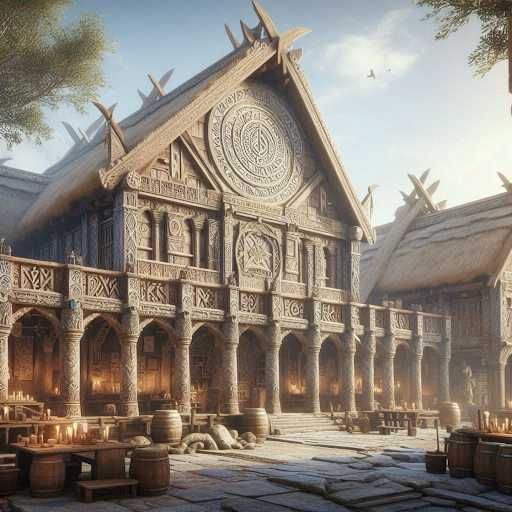
Interior: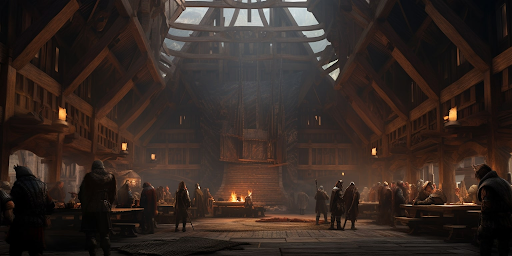
Wolkenruh
The valley in which Skyfather’s Hall is located, sacred ground for Thorists of all stature and a popular destination and meeting ground for pilgrims of Thorist and druidic nature alike.
A wide valley nestled between three moderately sized mountains, in the more northern part of Donnerwald. While it is true that rains and storms are frequent here, the average visitor would describe the climate as temperate and the average prevailing temperatures as pleasant for their respective season.
Two remarkable features of the valley are the joining of three mountain rivers (fed by the many glaciers further north through an almost innumerable amount of mountain streams) into Nebelsee lake (a fertile breeding ground for many fish species) before carrying onward as the mighty Donner river, and the presence of many ancient standing stones that Thorists prescribe religious meaning to.
A common saying about Wolkenruh shared among both pilgrims and jokester bards is that you’ll hear the thunder before you see Wolkenruh.
Duchy of Ironwood
For places and worldbuilding relevant to Ironwood
Village of Schmoop-Plate (formerly known as Shiny-Bottle Cove)
Village of Schmoop-Plate (formerly Shiny-Bottle Cove)
Location: Ironwood Coastline
-
If permitted in the setting the locals in the village are Kuo-Toa (the fish people). They do have psionic powers however, that make them manifest their god - the effect it might’ve had on Schmoop is making him change colours as they believe a god should be iridescent or something like the shiny bottle they worshipped previously.
History:
The village was originally called Shiny-Bottle cove as the locals were mesmerized by a shiny faceted bottle that washed up on shore.
Until the day Schmoop came crashing down into their village, obviously to the locals it must be the sign of a successor to Shiny Bottle.
On a silver platter they placed the dazed plasmoid on and proceeded to carry him around in reverence. When Schmoop was no longer dazed, they asked who had graced them with their presence. A confused Schmoop stated his name and so they renamed their village as Schmoop-Plate.
Potential Conflicts/Missions:
?
Duchy of Greycliff
Coalescium - Plasmoid/Awakened Ooze Sanctuary
Location: Southern Greycliff Border Closer to Vermillion in a swamp biome
An underground sanctuary for core-oozes and displaced plasmoids.
Schmoop is not aware of this place - yet.
Types of Plasmoids/Awakened Oozes:
- Sentience in an ooze is shown by having a glowing core - equivalent of a brain.
- Astral Plasmoids: the classic plasmoid from the stars/astral. There aren’t many of these around this world the ones that ended up here were from teleportation experiments with portal/gate/sigil circle mishaps or crash landed. Schmoop is an example.
- Awakened (Core) Ooze: an ooze that originated from a standard ooze species, however developed a core whether naturally occurring or from magical experimentation like an ooze that was from a failed experiment. An ooze with the core has the traits and abilities of a plasmoid - a trade-off for developing the core they lose the abilities of their base species that focuses on consumption.
Example: a Pudding-Core is a black pudding in appearance with a glowing core, it might smell vaguely like a black pudding, this is all flavour only no mechanical changes.
Example 2: a slithering-tracker is clear in its default design but a Glass-Core has a glowing core of some colour that would neutralize the translucency like light in a clear jelly blob.
Terminology:
-
-
- -Core suffix signifies an ooze with a sentient core
- -Slop suffix signifies a mindless ooze
-
Names for each Core Ooze Type
-
-
-
- Plasmoid -> Astral-Core
- Ochre Jelly -> Jelly-Core
- Black Pudding -> Pudding-Core
- Gelatinous Cube -> Cube-Core
- Gray Ooze -> Slate-Core
- Slithering Tracker -> Glass-Core
- Green Slime -> Moss-Core
-
-
They also have terminology for each ooze type that is core-less with -slop suffix like Pudding-Slop.
-
-
-
- Bone-bag: derogatory term for a non-ooze/non-amorphous creature
- Mimicoids: those core oozes who prefer to explore the world of the humanoids - they usually retain a humanoid shape.
- Amorphs: those that reject forming a humanoid shape as much as possible preferring their natural state.
-
-
Culture:
- Welcoming to fellow Core oozes
- Friendly towards Thorists (see history for why), they associate them with non-hostility.
- Also welcoming to friendly humanoids otherwise they keep well hidden try not to reveal their location for fear of being ransacked or worse.
- Rejection: sometimes the offspring (fission) of a core ooze or a plasmoid can result in a coreless ooze, these usually try to consume the source right away as the urge to consume takes hold and have no core. These oozes are taken to a fast flowing stream and sent downstream to maintain their status quo.
- Largely use a ooze/plasmoid dialect of common which may include unique terminology or musical-like sounds or body language for extra emphasis or subtle meanings.
- There are some that venture out to bring back resources like food or items to the matrix.
Study:
-
- Some of the Coalescium residents are curious to the humanoid cultures and world and choose to go off and adventure out to study magic, nature or other classes, and they usually always consider the Coalescium home (they have a natural instinct to return back to their home matrix). Some have formed their own small druidic circle, others share magic knowledge, or music, religion, or sword fighting skills etc.
- Some are connoisseurs of humanoid artifacts especially the Cube-Cores
Governance:
No rigid hierarchy usually the Founders (are they still alive?) will speak on behalf of the Coalescium or those who have interacted with the surface dwellers if the Founders are not present. They operate on a collective council basis to make decisions. They consider their founders to be heroes, however they do not have a superior status other than an honorary title - something they picked up from the humanoids, Founder/Elder.
World Integration:
Do they work in the larger centres as fulfilling some particular role like the street cleaners or sewer maintenance.
Architecture:
Entrance is set into a Cenote.
The colony is dimly lit by magical fungi that some of the ooze cultivate, the lights are arranged into patterns that are significant to some of the oozes (like a home constellation or a pattern of lights representing different symbols or matrices) because they are a visual light/sound based creatures in their natural ways of communication.
Structures are built into the walls or constructed of natural building materials. They flow into each other giving the appearance of a waved overlapping structure.
No stairs only ramps. Some buildings are humanoid friendly with large entrances, others are not. They have some structures with small entrances you have to be amorphous to squeeze into they use these as safe-rooms in case a hostile group came through (given their past experiences in the humanoid world they take precautions).
Network of tunnels connect their settlement in a tangled ant-colony way. The walls here are reinforced with a substance that gives the walls a smooth varnished feeling from the grit underneath.
Primary settlement built around the underground spring of the cenote.
History:
How long has it existed? This depends on the history of Eusia and the overall timeline, I think at a minimum it is well established.
The original founders of the Coalescium were a Jelly-Core (Apelsinsmetsen (the orange goop) they were named any the thorists and a displaced Plasmoid (Ulyss’zho - aka Ulysses, the ‘zho is their home matrix (similar to ‘iim for Schmoop (Verix’iim).
Apelsinsmetsen ended up at one of the stormward sanctuaries as a very young awakened ochre jelly where they grew up steeped in the mythology and culture of the thorists.
Ulysses was displaced from their home from some wizard’s experiment gone awry and they were teleported to this land. Ulysses quickly discovered of the xenophobia towards oozes and had to barely survive for some time, compared to where they came from.
Eventually Ulysses ran into Apelsinsmetsen and both inspired by their separate introductions to this world, strived to create a sanctuary for their kind in a world hostile to them.
Languages
What and how people speak
Celestial for Thorists
Because Thor is part of the Nordic pantheon, the celestial language of the Thorists is based on real-world Nordic languages (primarily Swedish, but also Icelandic, Norwegian/Danish, and variants like Faeroese).
Names of people and places in a Nordic indicate how important they are to the Halls. For example, a name like "Torbjörn" is an immense honour as you've literally received a name in the godly language.