South of the kingdom
The vast desert that splits the continent in half, and everything south from there.
- The Zahar
- Ri'Shara
- Donnerwald
- Oak Landing
- The Donner River
- Southern tundras
- Skyfather's Hall
- Wolkenruh
The Zahar
The Zahar sits south of Summervale on the eastern seaboard of the continent and next door to the vast central desert. As such, it forms the semi-arid region that separates heartlands of the kingdom of Eusia from the harsh deserts that belt the continent around the planet’s equator. It’s the native ancestral ground of the Tabaxi and home to various small tribal settlements. While operating semi-independently due to lack of government enforcement, the Zahar contributes to the overall prosperity of the kingdom by facilitating the transfer of overland goods through their caravans, and its defense through the fierce warriors the kingdom can call on in times of conflict.
Description: Zahar means “golden” and it’s a most fitting reference to the region as a whole. From the golden grass of its steppes to the beautiful sunsets native to the region.
The semi-arid nature of the region makes it poorly suited to large-scale agriculture. While the Zahar contains valuable resources such as precious stones and metals, most major extraction efforts are controlled by outside mining corporations that funnel wealth out of the region while providing limited benefits to local communities.
As a result, many Zahari live modest lives centred on hunting, gathering, herding, and survival in a demanding environment. This harsh upbringing is also one reason the region has a reputation for producing some of the kingdom's fiercest warriors, a fact the Crown readily remembers whenever it must raise armies during times of conflict.
For those not looking to scrape a meagre living off the land or fighting for their survival, the only other viable profession is to become a trader. In fact, Zahari trade caravans are such a reliable and dependable network of goods transport that they form the Eusian continent’s largest over land distribution system of goods. Either you sell your goods to a caravan (who will sell it on with a healthy profit) or hire them to deliver your goods to your customer. Their utility is so renowned that most people know that “Unless you can send it by ship, it will have passed through Zahari hands”.
And while some may look at the Zahar and wonder why anyone would want to live in a place that harsh, to those who were born there or who still call it their home it’s one of the most beautiful places in the world with unique flora, fauna, and opportunities.
Ri'Shara
Ri'Shara is a small settlement in The Zahar, but of great importance to both the Tabaxi and overland trade in the kingdom as the coordinator of the caravans (Nadira-who-Remembers) lives here.
It is known in the Tabaxi dialect as the "Place of Returning," Ri'shara is one of the oldest settlements in the Zahar and a cultural centre for the region's Tabaxi communities. Built around a permanent spring, it serves as a gathering place for nearby settlements and a departure point for many of the trade caravans that crisscross Eusia.
The settlement is home to Nadira-Who-Remembers, a respected elder responsible for coordinating caravans, preserving local traditions, and maintaining ties between distant communities throughout the Zahar.
Ri'shara exists because of water. Generations of Tabaxi settled around the spring at its heart, creating a permanent refuge within an otherwise harsh land. Unlike the towns and cities of the kingdom, Ri'shara has no walls, grand buildings, or formal streets. Clusters of homes, animal pens, market stalls, and communal shelters surround the spring before gradually giving way to the grasslands beyond.
Ri'shara is rarely quiet. Caravans arrive and depart throughout the year, bringing news, stories, and goods from across Eusia. Their return is often a community event, with friends and family gathering to exchange gifts, settle accounts, hear tales of distant lands, and welcome travelers home. While the settlement remains predominantly Tabaxi, merchants, craftsmen, laborers, and other travelers from across the kingdom are a common sight.
To outsiders, Ri'shara is an unremarkable oasis settlement. To the people of the Zahar, it is where journeys begin and where, sooner or later, every traveler returns home.
Donnerwald
The lush and dense forests that blanket the south of the Eusian continent, home to both various druidic circles as well as the biggest and most famous Open Hall of Thunder - Skyfather’s Hall.
A dense and dark forest named centuries ago by settlers who first attempted to travel further south from the central kingdom of Eusia for the frequent storms they encountered trying to cross it. Donnerwald is a temperate rainforest, consisting of leafy deciduous trees in the north to dense and ancient spruce, fir and pine trees further south. While the region is not home to any mountain range as imposing as the Stormcrown mountains, it’s decidedly blessed with elevation and features many misty valleys, fast-running mountain streams, and impressive waterfalls.
It’s also where the mighty Donner river stems from which is used as both a means of transportation in the southern parts of the continent, as well as a source of irrigation and drinking water to all who live near it.
Local folklore surrounding these forests is wide and varied, depending on who you ask and what their personal faith and profession are. Some claim that the trees themselves speak to ward off visitors, but this might simply be a charade created by the druids who have multiple circles here. Others claim that every thunderstorm on Eusia somehow makes its way to Donnerwald at least once, and that attempting to cut down a tree in the forest without seeking the blessing of Thor or the protection or the druid’s Oakfather will see you cursed to be killed by the falling tree itself.
Oak Landing
Oak Landing is the largest settlement in the southern reaches of the continent and sits on the Donner river at the edge of the deep southern forests of Donnerwald. It serves as the principal gateway between the forests of the south and the river trade of the north.
Built along the banks of the Donner, its busy docks see many timber barges, merchant vessels, and ferries carrying pilgrims, day in and day out. It’s a place of plentiful opportunity, from the laborers who keep the docks operating, to the merchants selling and trading wares on the markets, and the workers keeping its many warehouses stocked. Lumber cut in the Donnerwald, furs gathered in the southern wilds beyond the forest, and goods arriving from distant corners of Eusia all pass through Oak Landing's crowded warehouses and markets, as do many migrants and day laborers seeking work.
Oak Landing is formally governed by by a Baron, but much of the town's actual influence rests in the hands of merchant families and guildmasters whose fortunes are tied to trade along the Donner.
The presence of pilgrims bound for Skyfather's Hall and the deeper parts of Donnerwald, as well as trappers and hunters staging expeditions into the southern tundras add to the town's prosperity. Inns, outfitters, ferrymen, and traders compete for their business, combining with Oak Landing’s river trade to make it one of the busiest settlements in the county.
The Donner River
The mighty Donner river starts in the southern mountains of the Donnerwald and is both the largest supply of fresh water to the southern part of the continent as well as its primary trade route for shipping. Many traders have made their fortune on its banks in Oak Landing selling and trading goods and food arriving from the southern interior and timer and furs coming from the south.
Southern tundras
Once the thick forest of the Donnerwald thins, and you've conquered the various mountains in the region, you arrive at the southern tundra. This region, cold and unwelcoming at first glance, is actually home to a great variety of furry animals that have adapted to the climate and have become prime targets for hunters and trappers trying to find fortune.
While it's true that both the northern and southern tundra regions hold animals with these specific adaptations, the challenge posed by the mighty Stormcrown Mountains in the North means that for most sensible people the easy(easier) option is to head south instead.
In fact, so many have started to do this that it has lead to a small boom economy, with merchants in Oak Landing setting up shop to welcome the trappers and hunters coming in by boat to sell them all the supplies, equipment, and gear they may every need. At a significant markup, of course.
Skyfather's Hall
The oldest and wealthiest of the Open Halls of Thunder in Eusia, and a place of worship, study, debate, discussion, and learning for both Thorist clerics and paladins, as well as many followers of other earthen faiths such as druids and shamans.
The structure consists of a vast hall with multiple levels carved from timber with ornate decorations and runic inscriptions and wards everywhere. It houses multiple guest rooms, libraries, studies, a massive open-sky enclosed courtyard, a mead hall, and an immense central hall known as the Stormvoice which is often used for large events such as the aforementioned debates and discussions, but when not used as such, forms an open place of prayer for all who visit Skyfather’s Hall.
Exterior: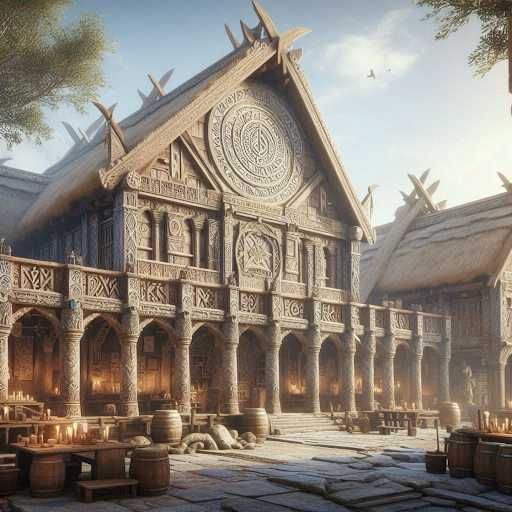
Interior: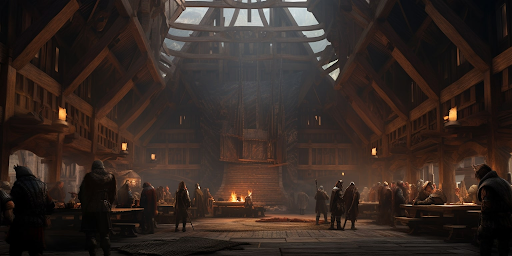
Wolkenruh
The valley in which Skyfather’s Hall is located, sacred ground for Thorists of all stature and a popular destination and meeting ground for pilgrims of Thorist and druidic nature alike.
A wide valley nestled between three moderately sized mountains, in the more northern part of Donnerwald. While it is true that rains and storms are frequent here, the average visitor would describe the climate as temperate and the average prevailing temperatures as pleasant for their respective season.
Two remarkable features of the valley are the joining of three mountain rivers (fed by the many glaciers further north through an almost innumerable amount of mountain streams) into Nebelsee lake (a fertile breeding ground for many fish species) before carrying onward as the mighty Donner river, and the presence of many ancient standing stones that Thorists prescribe religious meaning to.
A common saying about Wolkenruh shared among both pilgrims and jokester bards is that you’ll hear the thunder before you see Wolkenruh.