Duchy of Ironwood
The northeastern border province of the Kingdom of Eusia
Duchy of Ironwood
This Duchy in one of several which comprise the Kingdom of Eusia. It is lead by Duke Cedric Blackwood. It is a small duchy in the far north of the kingdom. It borders wild country on it's north, Duchy Greycliff to it's west, Duchy Broadwater to it's south, and the Eastern ocean to it's east. The Duke holds little sway in the grander politics of the kingdom. Despite being poorly represented in the King’s council, they are taxed quite heavily. The Wild North is seen by the king as rich and ripe for the harvest, but in reality it is too dangerous to reliably produce wealth from.
Exports: Iron ore, Charcoal, Lumber
Imports: Grain and Food, Mercenaries and Steel
The Duchal capital, Tollgate, is found in the County of Verstrad.
Counties:
- County of Timberfells
- County of Verstrad
- County of Mistshroud
Map:
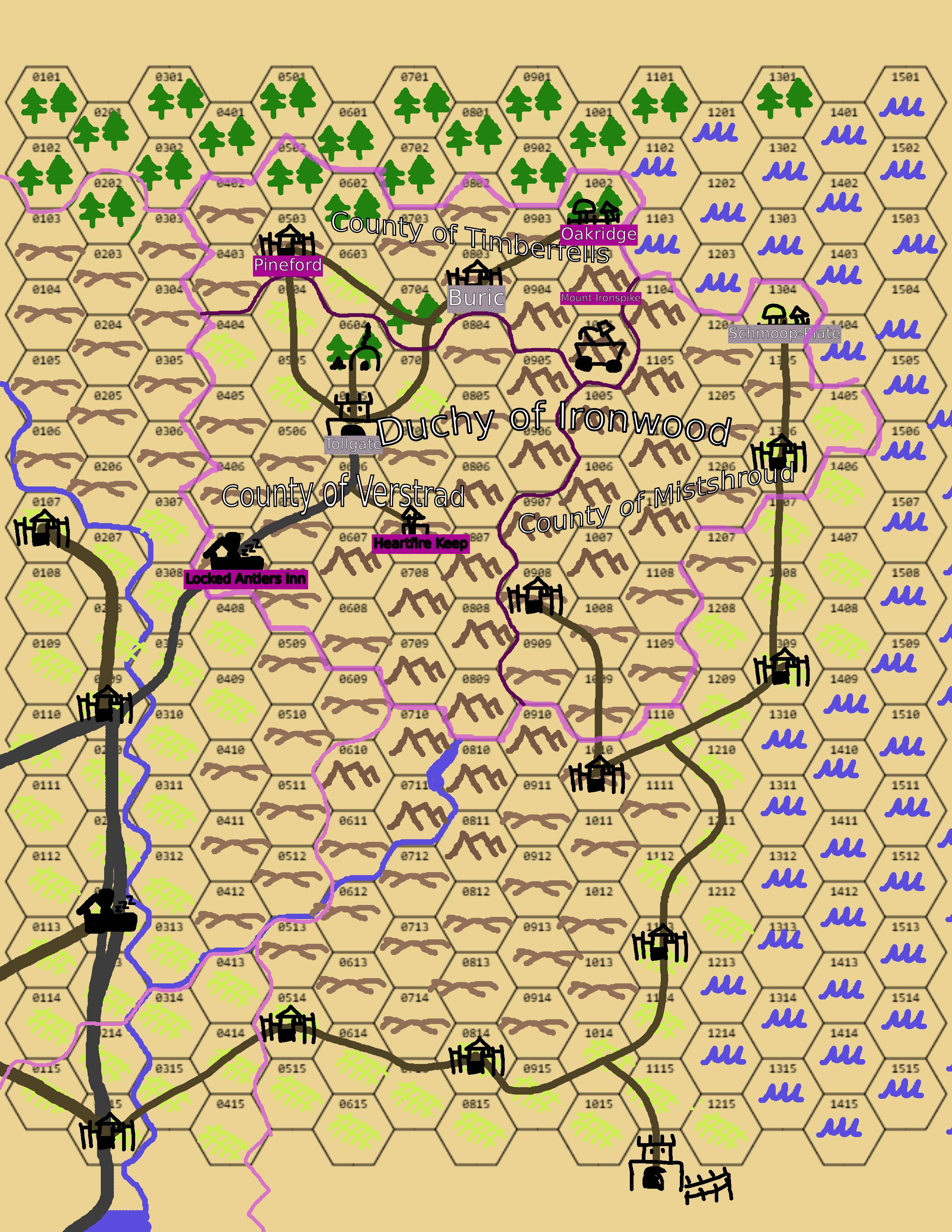
Schmoop-Plate
The village of Schmoop-Plate (formerly Shiny-Bottle Cove) is a north eastern coastal village in the [[County of Mistshroud]]. It is impossible for the Count to tax the Kuo-Toa that call this place home, but it would be very difficult and expensive to force them into compliance or otherwise annex their land. As such, they remain an oddity at the border between the wilderness and civilization.
As is typical of Kuo-Toa, a long and unending chain of "gods" have been worshiped in this village, and it's name usually changes to venerate the deity of the day. For many years, it was known as Shiny-Bottle Cove, but that changed when a strange rock careened out of the heavens onto the beach nearby. Inside of a small crater lined by quickly cooling glass was a very dazed ooze. The Kuo-Toa, knowledgeable in the way of ravenous oozes, initially made to dispatch of the creature. Luckily for [[Schmoop]], his consciousness returned in time for him to ward them off not with vicious attacks but with attempts at peaceful communication. Seeing that this creature was not a mindless ooze but a sentient being, the Kuo-Toa took the sign as divine and quickly carted him off to the village for worship and veneration.
The old religion, the Shiny Bottle, was quickly replaced by this new god who could move and speak, though not in a way that the Fish-men could understand. They did everything in their power to support his recovery and display their devotion. Before long, Schmoop was on a silver platter. When the Archpriest of the Shiny Bottle had finished respectfully disposing of the old god, he cast Tongues upon Schmoop and began to make inquiries. It was then that they learned of his name, and quickly renamed their entire society to honor their new god.
It was less than a day before Schmoop was recovered enough to leave by his own accord, and being an ooze meant it was not difficult for him to slip out of the shoddily constructed temple which he was being worshiped in. At a time when only a few of the Kuo-Toa were present, he playfully signed for them to cover their eyes, which they immediately did. Minutes later, when other Kuo-Toa arrived and angrily asked them where their god had gone, they had only the final command of their new deity to give: "He must've meant 'Hide and Seek!'"
Many villagers have since claimed to have found the hiding god, and keep closed containers in their home which they say contain His Holiness. This, of course, is not true, and so has lead to many fights and arguments blending reality with theology while the truth of Schmoop's disappearance remains unknown to them all.
Tollgate
Tollgate is the Duchal capital of the [[Ex Mortia/Locations/Kingdom of Eusia/Duchy of Ironwood/Duchy of Ironwood|Duchy of Ironwood]]. It lies within the [[County of Verstrad]]. [[Duke Cedric Blackwood]] rules from his Duchal estate within the northern district of the city, while [[Baron Joseph Dawkins]] sees to the day-to-day affairs of the City from within the southern Hall. It supports a population of 8000 people within it's walls, though that number balloons to about 12,000 with surrounding suburbs and dependent hamlets. The walls are 25 feet high in most places, but rise to 35 feet near the gates.
Layout
The city is built onto a hill, and is surrounded by stone walls. The area inside these walls is about one square mile of dense built-up area. The King's Highway enters the city through an enormous and old portcullis built into a great stone arch in the south wall. The weigh-house and storehouses are next to the gate. The Baron's Hall is not far from these, and sits adjacent to the market square. Further up the hill are more well-to-do houses. The top of the hill against the north wall sees the Duke's Estate, effectively a small castle which overlooks the surrounding country and city to it's south. There is a smaller gate near the castle, but it is generally not used by anyone who is not on official business, and acts as a means to maneuver during the defense of the city. Towers are found every 150 feet on important stretches (near the gate, castle, and hall) and farther apart elsewhere.
Food and Lodging
The city contains some 12 taverns, 4 large inns, 10 bakeries, 8 butchers, 10 breweries, and 4 public granaries/storage houses.
Trade and Finance
There is one general market square, 2 covered market halls, 3 moneylenders, 10 warehouses, 1 weighhouse, and 3 customs offices.
Craft and Repair
6 blacksmiths, one armorsmith and one weaponsmith, 8 carpenters, 4 coopers, 4 tanners/leatherworkers, 4 masons, 10 tailors, 5 cobbers
Civic and protective
8 guard posts, 3 gate houses (main gate, gate between lower and upper), 3 city watch barracks, 1 main court and 2 minor magistrate halls, one main prison below the Baron's Hall and several small lockups, one hospital and four alms houses.
The full wartime garrison capacity is 1000 soldiers, but currently the garrison actually comprises 450 men. Permanent guards number 150.
Religion and Learning
2 Major temples, 8 smaller chapels, 2 Monastic houses, 1 school
| District | Function | Est. Population |
|---|---|---|
| 1. Ducal Quarter | Duke’s estate, court offices, elite retainers, diplomatic housing | 700 |
| 2. Baron’s Ward | Barony hall, city administration, watch offices, tax clerks, guild oversight | 900 |
| 3. Market Ward | Main markets, stalls, inns, taverns, moneychangers, warehouses | 2,200 |
| 4. Crafts Ward | Smiths, tanners, leatherworkers, carpenters, coopers, small workshops | 1,700 |
| 5. Temple Ward | Major temples, cloisters, hospitals, schools, charity housing | 1,000 |
| 6. North Gate Ward | Garrison housing, armories, stables, road and gate support | 1,500 |
| 7. River/Lower Ward | Mills, docks if any, laundries, laborers, poor housing, waste trades | 1,400 |
| 8. Outer Boroughs | Farmers, handlers, common housing, service yards, seasonal workers | 2,500 |
Politics
To function adequately, the city should collect 14,000gp of taxes annually. In the last two years, they have struggled to collect more than 10,000gp. Thus, the garrison is thinning, repairs are being delayed, the walls are becoming neglected, guard patrols are fewer and less frequent, and the cities reputation has become one of harsh taxation. The Duke and the Baron are thusly very unpopular.
Processess
Standard Charges
| Situation | Cost |
|---|---|
| Foot entry | 1 sp |
| Mounted entry | 2 sp |
| Pack animal | 1 sp per beast |
| Cart / small wagon entry | 5 sp |
| Large wagon / caravan wagon | 1 gp |
| Trade goods inspection | 5 sp per load |
| Market stall, one day | 5 sp |
| Prime / covered stall, one day | 1 gp |
| Weighhouse / valuation | 2 sp per shipment |
| Warehouse storage, one day | 2 sp per crate or bundle |
| Bridge / gate / road use for goods | 1–5 sp |
| Exit toll, no goods | 1 sp |
| Exit toll, with goods | 5 sp per load or 10% of declared value, whichever is less |
| Sales duty | 10% of sale value |
These amounts are tuned so a routine stay usually drains a few silver pieces, while active trade can approach roughly 10% of a low-level party’s spending money.